
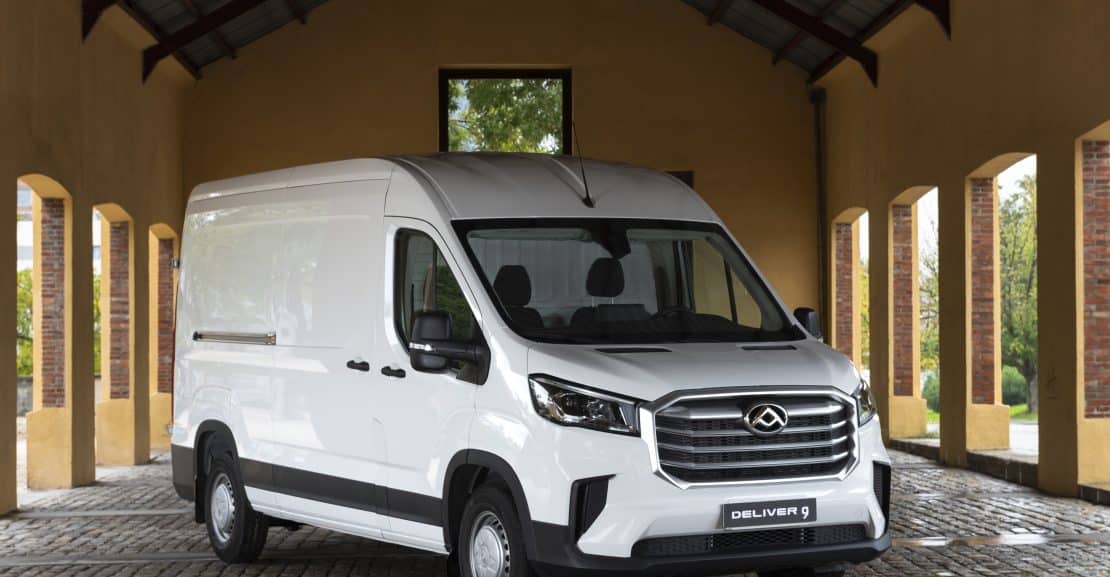
The Maxus e-Deliver 9 has been around Europe for a while now, but it's only recently starting to appear in Spanish fleets. It's a large, electric van with an L2H2 body and a powerful battery. The question isn't whether it makes sense on paper—it does—but whether it fits into the real-world operations of a Spanish last-mile delivery company.
First things first.
What is the Maxus e-Deliver 9 and why is it of interest to fleets?
Maxus is the van brand of the Chinese giant SAIC. In Spain, it is sold through its own network and already has a stable commercial presence, something that was uncertain just a couple of years ago. The e-Deliver 9 is its large, 100% electric van, designed to compete directly with the Ford E-Transit, Mercedes eSprinter, and Renault Master E-Tech.
The concept is simple: the same format as a standard Sprinter or Transit, but with an electric motor and a large battery underneath. No reinventing the wheel. And for a fleet that wants to enter Low Emission Zones without changing its practices, that continuity is key.
Motor, battery and performance: the numbers provided by the manufacturer
The four-door L2H2 version is equipped with an electric motor of approximately 150 kW (around 200 hp) and an 89 kWh battery. The official specifications state a top speed of around 100 km/h and a range of about 90 km—a figure that should be examined closely, as it corresponds to a specific configuration and does not necessarily reflect the full WLTP cycle that other manufacturers typically cite.
| kW power | HP power | Speed max. | Autonomy | Battery | Golden Label | Fuel Efficiency: |
|---|---|---|---|---|---|---|
| ≈150 kW | ≈200 CV | ≈100 km/h | ≈90 km | ≈89 kWh | ZERO | Electric |
Real autonomy: what to expect in urban operations
With an 89 kWh battery, the real-world range for urban deliveries—based on comparable usage in the segment—is between 200 and 250 km on a full charge and on mixed city-suburb routes. In winter, with heating and frequent starts, the figure drops. In summer, with a trained driver, it increases. Nothing new under the electric sun.
For last-mile delivery with a fixed base and overnight charging, it's more than enough. For a company that travels 300 km daily between industrial parks, it falls short without a fast-charging plan.
Payload, volume and logistical fit
The L2H2 configuration offers a cargo volume of around 11 m³, a figure comparable to a mid-size Transit. Payload is where the battery weight is a drawback: some of the cargo space you'd have available in an equivalent diesel van is taken up by the battery pack. This is the usual price to pay for large electric vans compared to their combustion engine counterparts , and the e-Deliver 9 is no exception.
Price and positioning: Is it really competitive?
The Maxus e-Deliver 9 L2H2 starts at approximately €73.400 MSRP. This is a manufacturer's suggested retail price, excluding dealer discounts, fleet promotions, and any incentives from the Auto+ Plan (which should be checked for updates on the official website). Please note: the MSRPs we provide are recommended retail prices, and in the commercial vehicle segment, the dealer's fine print can significantly affect the final price.
Is it competitive? Against the Mercedes eSprinter and the Ford E-Transit, yes — quite. Against an equivalent diesel, there's still a difference, although the numbers start to add up when you factor in maintenance and the Low Emission Zone (LEZ).
How it performs against its European rivals
This is where we need to be honest. The e-Deliver 9 performs well, has a large battery, and an aggressive price. But the interior feels a step below an eSprinter, the infotainment software is basic, and the after-sales network, although expanding, doesn't have the reach of a Ford or a Mercedes. For a large fleet that travels to Cuenca, Teruel, or Almería, that matters.
That said—and this is a fact—the entry cost is significantly lower. And in terms of total cost of ownership (TCO) over four years, with purely urban distribution, the difference narrows.
| Córdoba | HP power | Battery | Homologated autonomy. | price from | Fleet scoring |
|---|---|---|---|---|---|
| Maxus e-Deliver 9 L2H2 | ≈200 CV | ≈89 kWh | ≈90 km (data sheet) | ≈73.400 € | 7/10 |
| Ford E Transit Custom | View data sheet | View data sheet | View data sheet | View data sheet | 8,5/10 |
| Mercedes eSprinter | View data sheet | View data sheet | View data sheet | View data sheet | 8/10 |
| Renault Master E-Tech | View data sheet | View data sheet | View data sheet | View data sheet | 7,5/10 |
If the analysis focuses on the direct rival in terms of size and ambition, the Mercedes eSprinter sets the bar against which the Maxus has to defend itself.
Daily recharge and operations
It accepts DC fast charging at reasonable power levels for the segment—the exact figure should be confirmed with the dealership depending on the specific version. The logical strategy: overnight charging at 11 kW AC, and DC charging only when necessary. With this routine, a daily 200 km trip is perfectly manageable.
Who it suits (and who it doesn't)
It's a good fit for urban delivery companies with fixed bases, planned routes under 200 km/day, and price sensitivity. It's also a good fit for logistics operators who want to try electric vehicles without paying the premium segment's peak price.
It's not suitable for those who drive long distances, those who need maximum payload, or those who can't afford to be idle for a day waiting for a part to arrive from elsewhere. For that profile, a Ford or a Mercedes remains a safer bet.
Verdict
The Maxus e-Deliver 9 isn't the best large electric van on the Spanish market, but it's probably the one that offers the best price-performance ratio in its category right now. And that counts for a fleet decision. It remains to be seen how after-sales service will develop in three or four years—that's where these things really matter.
FAQ
What is the actual range of the Maxus e-Deliver 9?
The official specifications for the L2H2 version mention about 90 km, but in real urban operation with the 89 kWh battery, you can expect between 200 and 250 km of real range depending on load, weather and driving style.
How much does the Maxus e-Deliver 9 cost in Spain?
The recommended retail price starts at approximately €73.400, excluding discounts and subsidies. This is an indicative figure: the final price will depend on fleet discounts, promotional campaigns, and the current Auto+ Plan.
Is it compatible with the DGT's ZERO emissions label?
Yes. Being 100% electric, the e-Deliver 9 has a ZERO emissions label and can access Low Emission Zones in Spanish cities without restrictions.
Is it worth it compared to a Ford E-Transit or Mercedes eSprinter?
It depends on the use. For urban deliveries with a fixed base and a tight budget, the Maxus offers a very attractive price-performance ratio. For intensive operations, long distances, or areas with a limited after-sales network, a Ford or Mercedes remains a more conservative choice.