
Buying your first electric van as a self-employed person is nothing like buying a car. Here, the van is your business: if it doesn't start one day, you don't earn any money. And that weight influences every decision—from the vehicle segment to the charging point you'll install in your garage.
The good news is that by 2026 the Spanish car market will offer a real selection. The not-so-good news is that the differences between models are enormous, and you have to crunch the numbers before signing a contract. Let's break it down.
Why consider an electric van if you're self-employed?
If you drive urban or suburban routes of less than 150 km per day, return to your home base each night, and have a place to plug in, the equation starts to add up. The cost per kilometer plummets, you can enter Low Emission Zones without restrictions, and maintenance drops dramatically: no filters, belts, or oil changes.
Of course, it's not magic. If you live in an apartment without a designated parking space and work outside the city, the story changes considerably.
The three decisions that shape the purchase
Actual budget: it's not just the list price
The list price is misleading. An electric van for the self-employed needs to be considered in light of the total cost: less subsidies, more charging points, more insurance, less fuel savings, and maintenance over five years. The final figure is quite different.
Small city cars will cost you between €30.000 and €38.000 before subsidies. Medium-sized cars rise to the €42.000-€55.000 range. And a large electric car easily exceeds €60.000.
Useful autonomy: the real kind, not the one in the brochure
The WLTP range is an optimistic starting point. In winter, with a load, on the highway, and with the heater on, subtract between 25 and 35%. A van that's rated at 300 km in real-world driving will end up delivering 200-220 km under demanding conditions. That's the figure you have to work with.
Auto+ Plan subsidies: how they fit into your purchase
The Auto+ Plan is the current framework for public subsidies for the purchase of electric vehicles in Spain. It replaces previous plans and includes specific amounts for commercial vehicles, with the amounts varying depending on the vehicle category and whether you scrap an old vehicle. Check the official website for the current amount before signing—the fine print changes with each call for applications.
For a self-employed person, the aid can reduce the outlay by several thousand euros, but it arrives months after registration. Keep this in mind when planning your finances.
Small urban segment: local delivery
If your daily commute involves 80-120 km in the city, with short stops and light parcel or courier deliveries, this is the segment for you. You can park where others can't and you're fuel-efficient.
Renault Kangoo E-Tech (from €33.000)
The electric Kangoo is probably the most well-rounded option in the small van segment in Spain. It boasts a 45 kWh battery, a WLTP range of around 300 km, fast charging up to 80 kW, and cargo space that remains a benchmark. For intensive urban deliveries, it delivers.
| Power | WLTP autonomy | Golden Label | Fuel Efficiency: |
|---|---|---|---|
| 90 kW / 122 PS | ~ 300 km | Zero | Electric |
Citroën ë-Berlingo (from €31.500)
A French alternative with a similar approach and a slightly more aggressive price. The full comparison between the Citroën ë-Berlingo and the Ford E-Transit Courier is a good read if you're undecided between small city cars.
| Power | WLTP autonomy | Golden Label | Fuel Efficiency: |
|---|---|---|---|
| 100 kW / 136 PS | ~ 320 km | Zero | Electric |
Maxus e-Deliver 3 (from €32.000)
The Chinese option that has been gaining ground. Competitive price, generous payload for its size, and improved after-sales service. It's not the most refined, but for the price, it does an honest job.
| Power | WLTP autonomy | Golden Label | Fuel Efficiency: |
|---|---|---|---|
| 90 kW / 122 PS | ~ 213 km | Zero | Electric |
Nissan Townstar EV (from €32.500)
It shares a platform with the Kangoo but with Nissan's own adjustments and a commercial warranty that gives many self-employed people peace of mind.
| Power | WLTP autonomy | Golden Label | Fuel Efficiency: |
|---|---|---|---|
| 90 kW / 122 PS | ~ 300 km | Zero | Electric |
Medium segment: technical services and trades
This includes installers, technical services, light construction, and any self-employed professional who needs between 5 and 6 m³ of payload without sacrificing city mobility. In my opinion, it's the most interesting segment for making the switch to electric.
Ford E-Transit Custom (from €47.000)
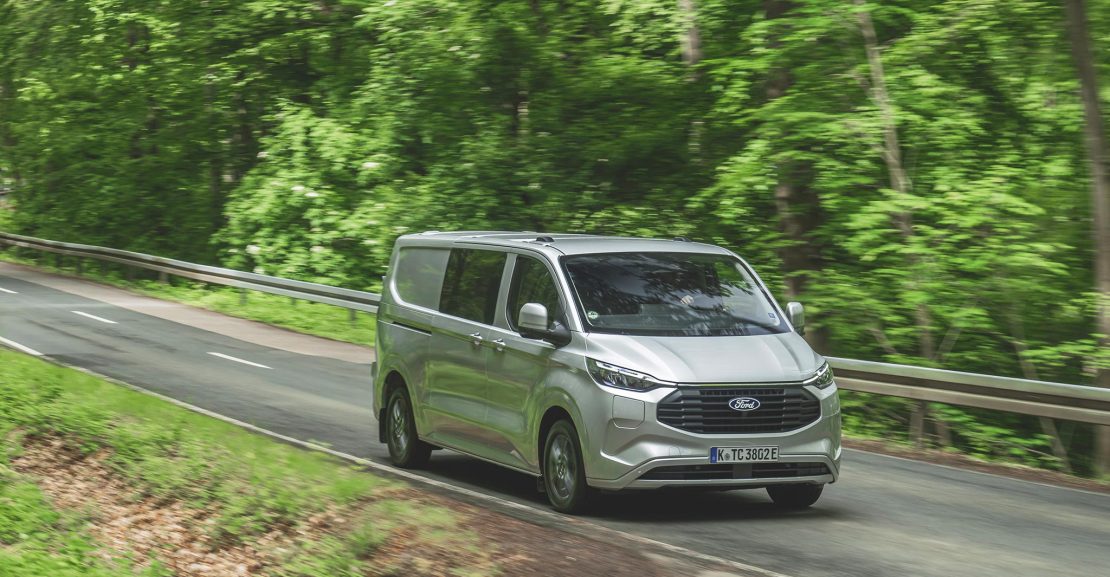
The electric Transit Custom is in a league of its own when it comes to refinement. With the larger battery, it boasts a WLTP range of nearly 380 km, fast charging is reliable, and the interior is arguably the best in its segment. Expensive, yes, but it's a serious contender for anyone who spends ten hours a day in their van.
| Power | WLTP autonomy | Golden Label | Fuel Efficiency: |
|---|---|---|---|
| 160 kW / 218 PS | ~ 380 km | Zero | Electric |
Peugeot e-Expert (from €44.000)
It shares a platform with Citroën and Opel, has a 75 kWh battery, and a real-world range of around 260-280 km in mixed use. It performs adequately without being particularly impressive, and its payload capacity holds up well in comparison with diesel rivals of the same size.
| Power | WLTP autonomy | Golden Label | Fuel Efficiency: |
|---|---|---|---|
| 100 kW / 136 PS | ~ 330 km | Zero | Electric |
Mercedes-Benz eVito (from €52.000)
The premium option. Next-level finishes and ergonomics, but you pay for the star. It makes sense if your personal brand relies on the vehicle's image.
| Power | WLTP autonomy | Golden Label | Fuel Efficiency: |
|---|---|---|---|
| 85 kW / 116 PS | ~ 360 km | Zero | Electric |
Volkswagen ID. Buzz Cargo (from €55.000)
It's the electric van that attracts the most attention on the street, and that's valuable for a self-employed individual with a visible brand. It has a range of around 400 km WLTP and a decent cargo capacity, although it's not the largest in its segment.
| Power | WLTP autonomy | Golden Label | Fuel Efficiency: |
|---|---|---|---|
| 150 kW / 204 PS | ~ 400 km | Zero | Electric |
Comparative table and scoring
| Córdoba | Segment | WLTP autonomy | price from | Punctuation in Spanish |
|---|---|---|---|---|
| Renault Kangoo E-Tech | Small | ~ 300 km | 33.000 € | 8,5 |
| Citroen ë-Berlingo | Small | ~ 320 km | 31.500 € | 8,3 |
| Maxus e-Deliver 3 | Small | ~ 213 km | 32.000 € | 7,2 |
| Nissan Townstar EV | Small | ~ 300 km | 32.500 € | 8,0 |
| Ford E Transit Custom | Median | ~ 380 km | 47.000 € | 9,0 |
| Peugeot e-Expert | Median | ~ 330 km | 44.000 € | 8,1 |
| Mercedes-Benz eVito | Median | ~ 360 km | 52.000 € | 8,3 |
| Volkswagen ID. Buzz Charge | Median | ~ 400 km | 55.000 € | 8,6 |
How to make the final decision
Before signing up, try this exercise: note your actual daily mileage from the last week, see where you'll be charging, and calculate the monthly fee with the subsidy already applied. If it helps, the guide by daily usage ranges will help you make a decision based on your user profile.
And don't buy battery life you're not going to use. It's the most expensive mistake.
FAQ
How much does an electric van for self-employed people really cost in Spain?
The range goes from around €31.500 for small urban cars (Citroën ë-Berlingo) to more than €55.000 for premium medium-sized cars (Volkswagen ID. Buzz Cargo), always before applying aids from the Auto+ Plan.
What real-world range can I expect compared to the official figures?
In professional winter use, with a load and air conditioning, it achieves 25-35% less than the WLTP figure. A van homologated at 350 km can achieve 230-260 km in reality.
Does the Auto+ Plan cover commercial vans?
Yes, it includes electrified light commercial vehicles with specific subsidies. Current amounts and conditions are updated with each call for applications; please consult the official website before purchasing.
Is an electric van worth it if I don't have my own garage?
It's more complicated. Without charging at a public charging station, you're dependent on the public network, which increases the cost per kWh and adds downtime. If your route allows charging at your destination or you have access to a reliable nearby charging point, it might still work; otherwise, consider other alternatives.