
Choosing a diesel van in 2026 is no longer what it used to be. Before, it was enough to look at the payload and the price; now you have to consider three layers—your usual route, traffic regulations, and the actual cost per kilometer—before signing a contract. And those three layers change a lot depending on whether you spend your day going in and out of a Low Emission Zone, mixing neighborhood and industrial park driving, or racking up 800 km of highway every week.
First things first.
Why route type matters more than brand
A modern diesel engine doesn't perform the same when starting from cold every 400 meters as it does when cruising at 110 km/h with the turbocharger fully seated. The DPF (diesel particulate filter) needs long regeneration cycles, and that's where intensive urban use ruins many poorly chosen vans. We've seen it a thousand times: a self-employed person buys a large van "just in case" and spends the year in the workshop with warnings of incomplete regeneration.
The key, in our opinion, is honesty: how many kilometers do you travel per day, at what average speed, and with how many stops?
Urban profile: city, LEZ and continuous stops
Maneuverability, environmental rating, and a small engine that doesn't struggle when cold are key here. We're talking about last-mile delivery drivers, local installers, and technical services operating within a 30-40 km radius.
Peugeot Partner — from €21.500
Peugeot's smallest car remains a benchmark among urban freelancers. Its 1.5 BlueHDi 100 hp engine is economical, easy to drive, and fits in any low-emission zone with a C label. In practice, real-world fuel consumption is below 6 l/100 km if you're not fully loaded.
| Power | Consumption | Golden Label | Fuel Efficiency: |
|---|---|---|---|
| 75 kW / 100 PS | 5,8 l / 100 km | C | Diesel |
Citroën Berlingo Van — from €21.200
The Partner's technical sibling, with a slightly softer suspension setup that's appreciated on cobblestones and speed bumps. Same BlueHDi engine, same emissions standard, same urban spirit. In my opinion, the interior feels a step below the Peugeot, but it costs a bit less.
| Power | Consumption | Golden Label | Fuel Efficiency: |
|---|---|---|---|
| 75 kW / 100 PS | 5,9 l / 100 km | C | Diesel |
If your day is spent entirely in the city, we've already talked about the small diesels with the best real-world fuel consumption , and the pattern repeats itself: a small engine that's well-tuned is better than 130 hp wasted at 40 km/h.
Mixed profile: neighborhood in the morning, industrial park in the afternoon
The most common scenario in Spain. You start by delivering in the city center, have lunch near the ring road, and in the afternoon you cover 60 km of highway for deliveries to industrial parks. Here, the medium-sized diesel van is the undisputed queen.
Ford Transit Custom — from €30.900
The current Transit Custom is, quite simply, the best diesel midsize van you can buy in Spain today. Its 2.0 EcoBlue engine with 136 hp delivers torque from very low down (390 Nm), and the chassis handles almost like a passenger car. Real-world fuel consumption: 7-7,5 l/100 km in realistic mixed driving. C emissions sticker.
| Power | Consumption | Golden Label | Fuel Efficiency: |
|---|---|---|---|
| 100 kW / 136 PS | 7,2 l / 100 km | C | Diesel |
Volkswagen Transporter — from €33.500
The Transporter is in a different league in terms of perceived quality, although the price reflects that. Its 150 hp TDI engine is a comfortable companion for racking up the miles and comes well-equipped as standard. However, I'm not entirely convinced by its price-to-payload ratio compared to the Ford.
| Power | Consumption | Golden Label | Fuel Efficiency: |
|---|---|---|---|
| 110 kW / 150 PS | 7,4 l / 100 km | C | Diesel |
Opel Vivaro — from €28.900
A close cousin of the Peugeot Expert and Citroën Jumpy (based on the Stellantis platform), the Vivaro has carved out a niche for itself thanks to its price and a 2.0 BlueHDi 145 hp engine that performs very well on the highway without compromising fuel economy in urban driving. It's a good middle ground for those who don't want to pay the premium for the Transporter or settle for a less powerful engine.
| Power | Consumption | Golden Label | Fuel Efficiency: |
|---|---|---|---|
| 106 kW / 145 PS | 7,1 l / 100 km | C | Diesel |
To delve deeper into this segment, we have a Transit Custom vs Peugeot Expert duel that complements what we have summarized here.
Highway profile: long routes, heavy loads, tough kilometers
If your day starts on the AP-7 at seven in the morning and ends 600 km later, forget about medium-sized trucks. You need a large fuel tank, an engine with plenty of torque, and a cab that won't wreck your back. That's where the big guys come in.
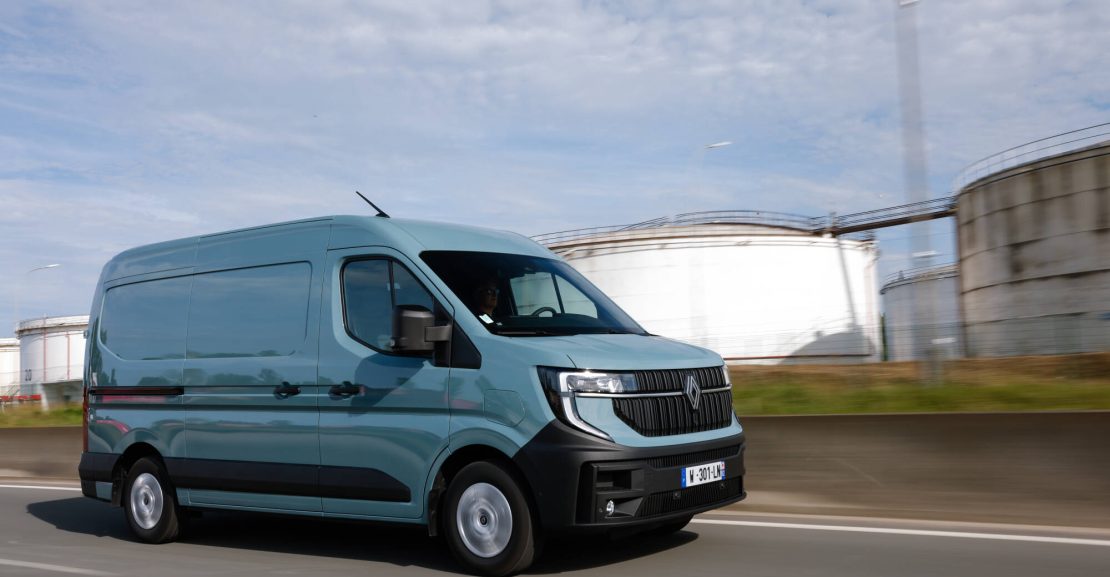
Renault Master — from €32.400
The Master has been a sales leader for years for a reason. Its 2.0 Blue dCi 170 hp engine moves a fully loaded L3H2 with ease, and highway fuel consumption is around 8-8,5 l/100 km if you maintain a speed of 110 km/h. It has a C emissions rating.
| Power | Consumption | Golden Label | Fuel Efficiency: |
|---|---|---|---|
| 125 kW / 170 PS | 8,3 l / 100 km | C | Diesel |
Ford Transit — from €33.200
The large Transit remains the benchmark for long-distance reliability. Its 165 hp 2.0 EcoBlue engine consumes slightly more fuel than the Master, but it offers a chassis that handles tough routes better than anyone. For those who live on the highway, it's a sure bet.
| Power | Consumption | Golden Label | Fuel Efficiency: |
|---|---|---|---|
| 121 kW / 165 PS | 8,6 l / 100 km | C | Diesel |
Mercedes-Benz Sprinter — from €38.500
The Sprinter is in a league of its own: a premium cabin, German-grade soundproofing, and a 170 hp OM654 engine that handles the daily 1.000 km like a trip to the supermarket. It costs more, yes, but for heavy highway driving, it's worth it.
| Power | Consumption | Golden Label | Fuel Efficiency: |
|---|---|---|---|
| 125 kW / 170 PS | 8,4 l / 100 km | C | Diesel |
Volkswagen Crafter — from €36.900
The Crafter completes the trio of larger models with excellent dynamic handling and a well-designed driving position. Its 2.0 TDI engine, producing 177 hp, is the most powerful in the group. It remains to be seen whether its after-sales service in Spain will match the Ford or Mercedes networks in medium-sized towns.
| Power | Consumption | Golden Label | Fuel Efficiency: |
|---|---|---|---|
| 130 kW / 177 PS | 8,7 l / 100 km | C | Diesel |
DGT and ZBE labels: what changes the game
All current Euro 6d diesel vehicles have a C emissions label. This is sufficient for driving in most Spanish Low Emission Zones (LEZs) today, but there are increasing restrictions in Madrid Central, Barcelona's Ring Road LEZ, and those coming to Valencia and Seville. If your work area will be within a LEZ five days a week, seriously consider whether a new diesel vehicle has a ten-year lifespan or if the current situation calls for a different technology. Subsidies like the Auto+ Plan are geared towards electrification, not diesel—check the official website for current amounts.
Comparative summary table
| Córdoba | Segment | Ideal route | Actual consumption | Punctuation in Spanish |
|---|---|---|---|---|
| Peugeot Partner | Small | City | 5,8 l | 8,5 |
| Citroen Berlingo Van | Small | City | 5,9 l | 8,2 |
| Ford Transit Custom | Median | Mixed | 7,2 l | 9,2 |
| Volkswagen Transporter | Median | Mixed | 7,4 l | 8,4 |
| Opel Vivaro | Median | Mixed | 7,1 l | 8,6 |
| Renault Master | Grande | Highway | 8,3 l | 9,0 |
| Ford Transit | Grande | Highway | 8,6 l | 8,9 |
| Mercedes-Benz Sprinter | Grande | Highway | 8,4 l | 9,3 |
| Volkswagen Crafter | Grande | Highway | 8,7 l | 8,7 |
FAQ
Which diesel van is best for city driving with frequent stops?
A small van like the Peugeot Partner or Citroën Berlingo with a 1.5 BlueHDi engine. It has a small engine, a DPF that regenerates with occasional short motorway cycles, and a C emissions sticker for access to low-emission zones. Avoid large vans if you're not going to be driving long distances: you'll struggle with the particulate filter.
How much fuel does a diesel van actually consume on the highway?
A medium-sized van gets around 7-7,5 l/100 km at 110 km/h; a large van like a Sprinter or Master gets between 8 and 9 l/100 km depending on the load. Exceeding 120 km/h increases fuel consumption by 15-20% due to the aerodynamics of the high cargo bed.
Can I buy a new diesel van in Spain in 2026 without any problems?
Yes, they are selling normally. All new ones have a C sticker and comply with Euro 6d. The restriction will be phased in gradually in large Low Emission Zones starting in 2028-2030, but intercity and motorway use is guaranteed in the medium term.
Is a large diesel worth it if I only drive 15.000 km a year?
It's unlikely. At that mileage, the payback period compared to a gasoline or hybrid engine is much longer, and diesel performance suffers if you don't drive long distances. For annual mileages below 20.000 km, it's worth considering alternatives—a mid-size diesel or even an electric vehicle, depending on your route.