
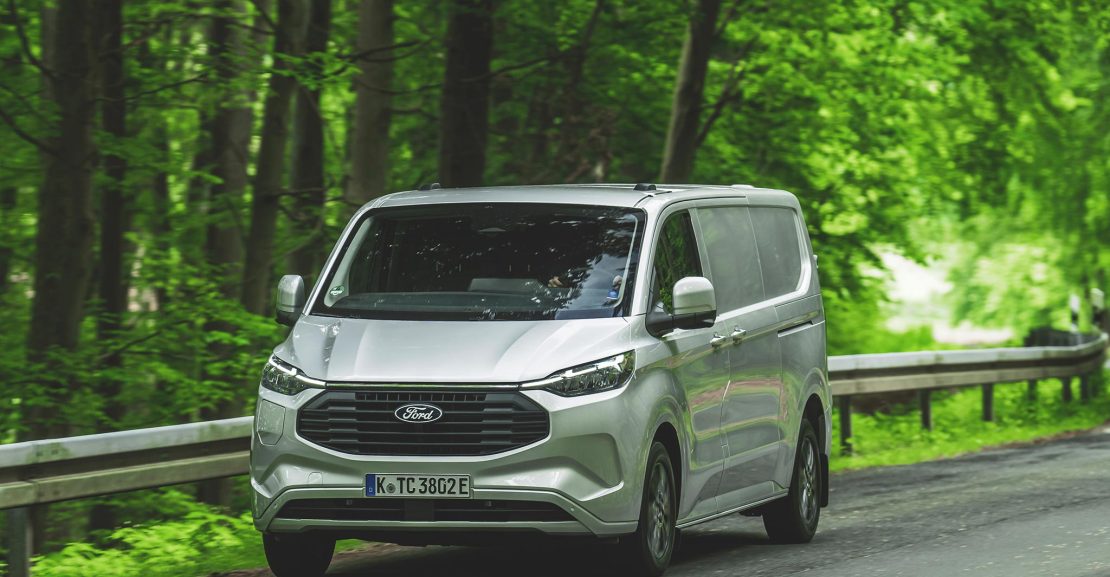
Some vans are bought because they're trendy, and others are bought simply because they work. The Ford Transit Custom diesel has been in the latter group for years, and in the world of Spanish self-employed drivers, that's worth more than any marketing campaign. It's the medium-sized van you see parked in any industrial park, at any construction site, on any delivery route. And that's no coincidence.
Let's see why it remains the benchmark — and where the pressure from its rivals starts to show.
Why the Ford Transit Custom continues to dominate the mid-size segment
The mid-size segment in Spain is probably the most competitive in the light commercial vehicle market. And yet, the Transit Custom has been the top seller for years. The reason isn't just one: it's the combination of a well-established Ford Pro after-sales network, a wide range of body styles, and a product that has been refined smoothly generation after generation.
In our opinion, what matters most to the self-employed is the ease of finding spare parts and repair shops. You can be in Cuenca, Lugo, or Cádiz, and the problem is solved. In practice, that translates into money.
Load versatility: two lengths, two heights, and variants that cover almost everything
The Transit Custom is offered in two wheelbases and two roof heights, with panel van, crew cab, and Kombi configurations. For an air conditioning installer, the L1 with a standard roof already covers 90% of their daily needs. For a self-employed mover or a sign maker with bulky materials, the L2 with a high roof makes all the difference.
However, if you're working with heavy loads in a confined space—think of a plumber with lots of equipment and little clothing—the actual payload is lower than what the technical specifications claim once you add shelving, a ladder, and a water tank. This is a recurring issue in the industry, and we've addressed it in our article on actual payload versus specifications.
Cabin and ergonomics: the generational leap is noticeable behind the wheel
Ford has really hit the jackpot here. The cabin of the current Transit Custom feels almost like that of a premium passenger car: a large SYNC 4 screen, a steeply raked steering wheel like a city bus, and a gear lever mounted high on the center console. For someone who spends 40.000 km a year inside, the difference compared to the previous generation is enormous.
The driver's seat with lumbar support, storage compartments everywhere, and standard sliding side door access to the trunk complete a well-designed workspace. Is it perfect? No. The quality of some of the hard plastics on the dashboard reveals that it's still a van, not an SUV. But it's acceptable.
EcoBlue diesel engines: the heart of the catalog
The 2.0 EcoBlue diesel engine powers almost all Transit Custom vans registered in Spain. It's available in several power outputs and offers the option of front-wheel drive and an eight-speed manual or automatic transmission. It has a C emissions rating from the DGT (Spanish Directorate General of Traffic).
For the average self-employed driver's mixed city and highway driving, the intermediate option is, in our opinion, the most recommendable: it has more than enough power to maneuver fully loaded without excessively impacting fuel consumption. The automatic transmission is worthwhile if you do a lot of city driving; for pure highway driving, the manual still makes sense.
| Córdoba | Fuel Efficiency: | DGT Label |
|---|---|---|
| Ford Transit Custom | Diesel | C |
The catalog prices are the manufacturer's recommended retail price and do not include dealer discounts, special offers or purchase incentives such as the Auto+ Plan.
Direct rivals: how it positions itself against the competition
Volkswagen Transporter — from approximately €38.000
The new generation Transporter shares a platform with the Ford Transit Custom, curiously enough. In other words: Ford chassis, German engineering. It costs a bit more initially, and its dealer network is smaller in rural areas. It has its market for self-employed drivers who prioritize brand image and interior finish. For those focused on cost per kilometer, the Ford usually comes out on top.
Renault Trafic — from approximately €30.000
The diesel Trafic is probably the most competitive rival in terms of price. It boasts a 2.0 Blue dCi engine with a good track record of reliability, a comfortable cab, and a competitive payload. Its weak point, in practice, is its onboard technology, which feels a step below the Ford. Even so, for many self-employed individuals on a tight budget, it remains the logical choice.
Opel Vivaro — from approximately €29.500
The Stellantis (shared with the Peugeot Expert and Citroën Jumpy) has the advantage of a more compact exterior, useful for city driving, and a complete diesel range that includes the recent 150 hp version for demanding jobs. On the downside: less maximum cargo volume than the Ford and less comfortable cab ergonomics for taller drivers.
Actual cost of use: where you win and where you lose
In real-world combined driving conditions, the Transit Custom performs similarly to the Trafic and Transporter—there's little difference between the three, let's not kid ourselves. Where Ford has the advantage is in maintenance intervals and parts availability. A clutch, a gearbox, a turbocharger: everything is replaced faster and, almost always, cheaper.
That doesn't change the fact that insurance for a Transit Custom tends to be somewhat more expensive than that of an equivalent Trafic due to its higher new value. Each self-employed individual should do their own calculations before deciding; if it helps, the guide on how to choose a diesel van based on mileage and location is a good starting point.
Price and equipment: what the self-employed get for their money
The Transit Custom diesel starts at around €32.000 MSRP in its entry-level Trend trim, and rises to nearly €45.000 in the well-equipped Sport trim. These are indicative figures, without discounts. Compared to the Transporter, it's cheaper; compared to the Trafic and the Stellantis trio, it's slightly more expensive—but with more standard technology.
Verdict: It remains the benchmark, with some nuances.
For today's self-employed Spaniard, the Ford Transit Custom diesel is the most well-rounded option in the mid-size segment. It offers versatile body styles, a modern cab, a powerful engine, and an after-sales network that gives the competition nightmares. Is it the cheapest? No. Is it the most fuel-efficient? Not really. But it's the most reliable, and when your van is your office, that's invaluable.
Summary table and scoring
| Córdoba | Price from (indicative) | Versatility | Cabin ergonomics | After-sales network | Cost of use | Overall score |
|---|---|---|---|---|---|---|
| Ford Transit Custom | ≈32.000 € | 9/10 | 9/10 | 10/10 | 8/10 | 9/10 |
| Volkswagen Transporter | ≈38.000 € | 8/10 | 9/10 | 8/10 | 7/10 | 8/10 |
| Renault Trafic | ≈30.000 € | 8/10 | 7/10 | 9/10 | 8/10 | 8/10 |
| Opel Vivaro | ≈29.500 € | 7/10 | 7/10 | 8/10 | 8/10 | 7,5/10 |
| Peugeot Expert | ≈29.500 € | 7/10 | 7/10 | 9/10 | 8/10 | 7,5/10 |
| Citroën Jumpy | ≈29.500 € | 7/10 | 7/10 | 9/10 | 8/10 | 7,5/10 |
FAQ
Which diesel engine should I choose for the Ford Transit Custom for mixed use?
The 2.0 EcoBlue in its mid-range trim is the most balanced option for self-employed drivers who combine city and highway driving. It offers sufficient power when fully loaded without significantly increasing fuel consumption. The eight-speed automatic transmission is a plus if you do a lot of city driving.
Can a Ford Transit Custom diesel enter a Low Emission Zone (LEZ) with a C sticker?
Yes, currently the C sticker allows access to Low Emission Zones in most Spanish cities for commercial vehicles, although with increasing restrictions. It's advisable to consult the specific municipal regulations for your usual work area, as conditions vary.
How much does it cost to maintain a Ford Transit Custom versus a Renault Trafic?
In terms of official service intervals and parts prices, both are very similar. Ford's real advantage lies in the density of its Ford Pro network: workshops specializing in light commercial vehicles in almost every province, which reduces downtime.
Is it worth waiting for the electric E-Transit Custom version?
It depends on your needs. If you mostly make short urban trips with charging stations, the E-Transit Custom is a serious contender—starting at around €44.800 (RRP) and offering a range of approximately 370 km. If your daily commute involves a lot of highway driving or rural routes, diesel remains the sensible option for now.